


All in the Family
Some of you may already know that I’m married to a photographer. Peter has been shooting for 20+ years and has had the pleasure (obligation?) of shooting me for the full duration of our relationship. Such a good sport!
Beyond photographing me ad nauseam he has built an artistic practice I really admire and respect. It takes a long time to become good at something and he has put in his the work. We don’t often talk shop but I thought who better to ask about the artist’s rule of thirds than my in-home repository of art knowledge!
Rule of Thirds
When I talk styling I often reference the rule of thirds when we’re building an outfit. This has become a common term in the styling community but it has its origins in art. To help me figure out why it works and the history behind it, I asked Peter to help me break it down.
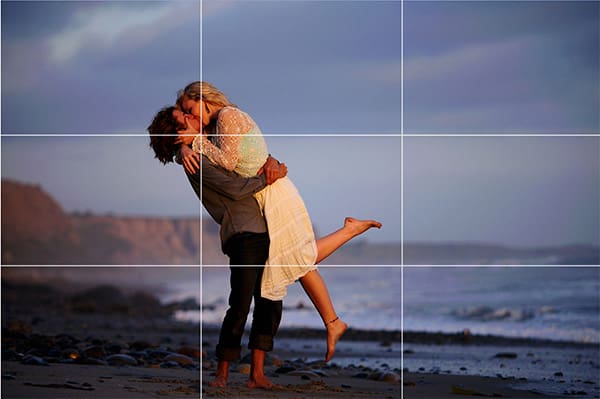
I first of all wanted to know what the rule of thirds actually is. I mean, I understand a good outfit should ideally be broken down into thirds but, before its fashion application, what does it actually mean? Essentially, he says, “it’s a photography technique that divides an image into nine equal parts using two horizontal and two vertical lines. Placing key subjects or elements along these lines, or at their intersections, creates more balanced, engaging, and energetic compositions than centered subjects.” So this rule makes something more interesting to look at. We may not be able to clock immediately that an image has followed the rule of thirds but when it’s explained I can definitely identify it more quickly.
It’s in the Eye
Next I wanted to know if our eye is actually seeking thirds, like if it’s a visual that we unconsciously sort of crave, or something else. In short? Yes. “In photography, the eye does not actually crave perfect symmetry,” he says. So something divided in half is kinda not the vibe actually. Instead, he says, the eye “craves visual balance, order, and dynamic tension.” Interesting. So it’s not because it’s predictable (half and half for instance) but actually almost because it’s not predictable. “The rule of thirds is effective because it simulates a ‘gentle imbalance’ or ‘dynamic asymmetry,’ which is more engaging to the human brain than a static, centered, or perfectly symmetrical compositions.” So it makes an image more interesting by visual complexity.
Back to the Closet
When I talk to clients I typically tell them we want to try to avoid cutting our body in half (in photographic terms, perfect). If we cut ourselves in half, half typically falls at our hips and no matter your size, shape, height or weight your hips are almost always your widest part. So by pulling your top down to “cover” your hips, for example, you’re accidentally drawing a line exactly across your widest point and actually drawing attention to that feature AND also shortening the visual of your lower half and making yourself look shorter. Bummers all around!
In photographic terms, Peter says “when an image is divided exactly in half rather than thirds, it fundamentally shifts from a dynamic feeling to a static one. It loses energy, becomes predictable and less interesting to look at.” In other words, in addition to drawing attention to our widest feature it’s also kind of boring to look at. Thirds help us build complexity and interest into our looks. I like it!
Break it Down
So turns out this photographic term although not imagined with fashion in mind, actually can help us contextualize our outfits and gives us the why behind why some things just feel like they look better. Our eye is looking for that little bit of imbalance, that interesting element. And when you’re getting dressed? Your waist is a fool proof way to draw a line between the top one third and bottom two thirds. So? Use your waist. Whether that’s with a belt, a little roll of the sleeves or a strategic tuck. Use the rule of thirds to give the eye something interesting to take in and level up your style game.
Questions? Send me a quick note here! I love talking shop.


Comments will load here